George Cadwalader and Penikese Island School
‘If I’ve turned a potential murderer into a car thief then it’s all been worthwhile’, concluded Major George Cadwalader (1939-2024) about Penikese Island School, which he founded in 1973. Wounded in Vietnam by a landmine, Cadwalader became a marine instructor, and he saw how marines who came from broken homes suffered more than others. Returning home to Massachussetts in 1970, working as an administrator at Woods Hole’s famous Oceanographic Institute, he continued to wonder ‘how to cure delinquency’, despite having no specific qualifications. Flicking through the papers one day, he read that the state was looking for private rehabilitation programmes for minors. Soon after, he happened to spot Penikese Island from a plane—ideal for a school, he thought, his mind doing cartwheels. He cajoled diverse friends into the enterprise. The founding team—former colleagues at the Institute, and a few ‘well-educated social drop-outs’—were ‘an array of unlikely teachers’.
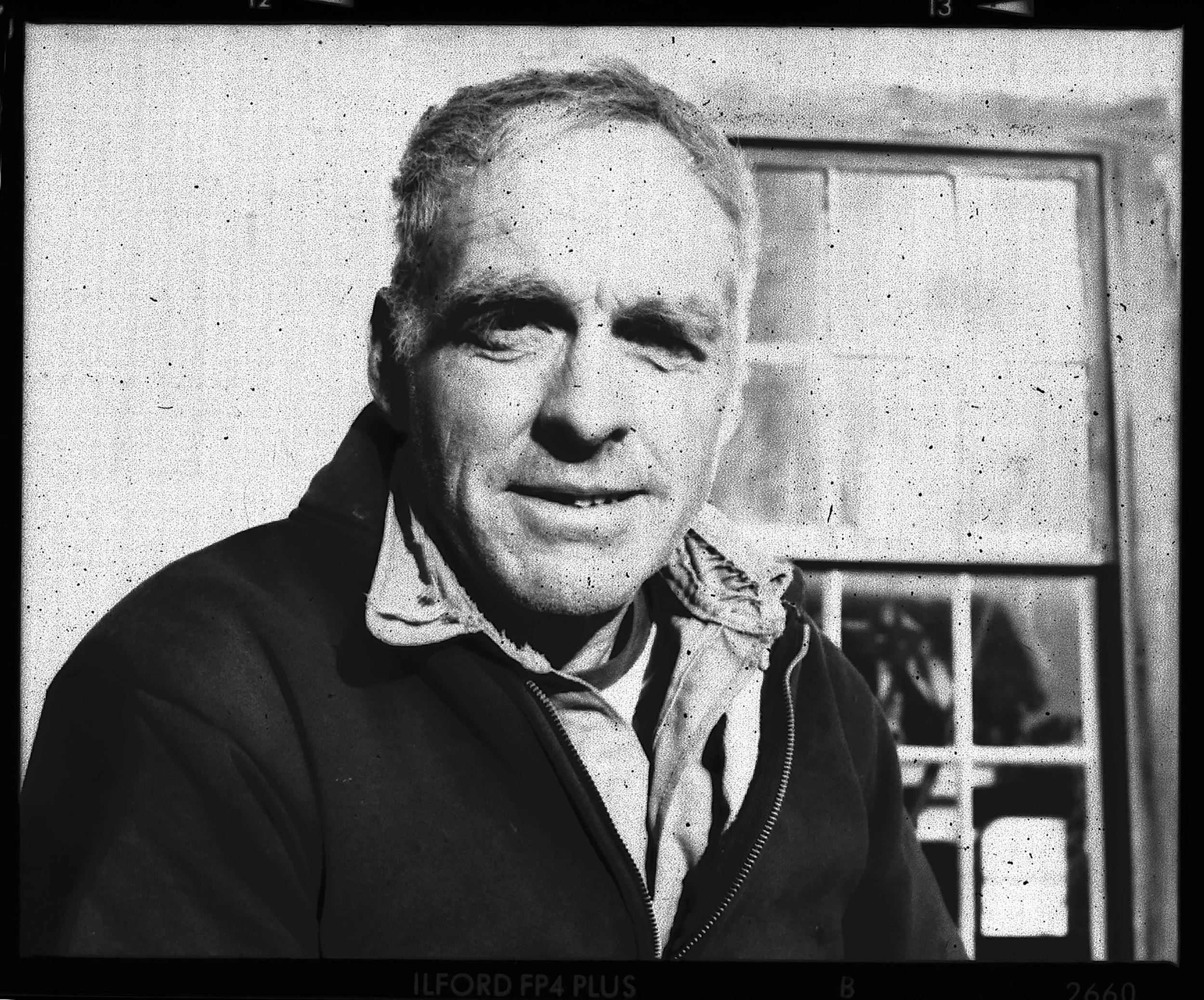
George Cadwalader at the boatyard, Woods Hole 1998
The smallest of the Elizabeth Islands, which sit between Buzzard’s Bay and glamorous Martha’s Vineyard, Penikese was then abandoned except for birds—it was a dedicated bird sanctuary. Yet its old ruins, some from the start of the century’s leper colony, were often vandalised, and litter shuffled about in the wind. At least their potential vandals could be monitored, Cadwalader suggested to the wary conservationists, ‘and surely a school would deter others?’, he insisted, doubtless with his terrific charm. The school’s first charges, referred by Massachussetts’ Department of Youth Services, were then rallied into the building of the new reform centre—‘their house’, as they soon called it. During the build, everyone lived on an eighty-five foot coastal freighter moored in Woods Hole, setting the scene for the unusual detention centre, which ran until 2011.
The island setting was crucial, but not for the romance of remote island existence. Remembering how his Yale degree was mocked by his marine sergeant—‘candy-ass brains…what this outfit needs is balls’—Cadwalader saw how an ‘abrupt transition between worlds’ helped shift someone’s thinking—previous norms no longer brought respect. The boys, generally urban street children, ‘didn’t know about cause and effect’, he explained, ‘growing up in an arbitrary world with parents who would love them one day and then get drunk and beat them up the next, even if the kid behaved exactly the same way’. Fear breeds violence, and the boys had lived in fear: they became ‘reactionaries and chameleons’ whose self-respect depended on often violent machismo. Cadwalader hoped that on the island, severed from usual realities, the boys would realise that when challenged, their instinctive aggressive reactions would be useless and they would change. The windswept island, with its sandy beaches and wild flowering shrubs, and despite the ever-screeching gulls, was peaceful—the ‘magic of Penikese’ would also help erode the boys’ confused thoughts.
Creating a family-like environment of ‘tough love’ in rural isolation, Cadwalader sought to combat the boys’ experiences that ‘honesty didn’t pay’, and teach them accountability for their actions. The boys who had built the school had learnt this lesson bluntly, literally shaping the environment they would live in. As Penikese co-founder David Masch put it, ‘Kids rarely see how their labours affect their well-being’. At the school, they saw how ‘the quality of their life on the island, and their success or failure in the programme [would be] their own responsibility’, Wates noted.
Small numbers were key. The school would be as much a home as a prison; many of the first boys had essentially been homeless. For up to a year, six or eight young offenders served their time alongside three or four staff—male and female—who rotated on a weekly basis. One was also a teacher, and one also a cook. Staff were not social workers but people ‘who embodied the same qualities we hoped to foster in the boys’. If a boy got angry, the staff would get angry back; if a boy did well, he got genuine praise from people he had come to admire. Cadwalader disliked how, as he saw it then, social workers seemed to pander to or attempt to befriend troubled youth. Chiefly for him, staff had to know ‘when to bear down and when to back off’.
Dan Robb, a teacher during the early nineties, found his crop of students to be ‘as diverse as their crimes’. Coming from Caucasian, Hispanic and African-American backgrounds, one was doing time for attempted murder, two for arson, one for assaulting his mother’s boyfriend with a baseball bat, one for breaking and entering, one for robbery, and one for dealing drugs. The single common factor was their broken homes. Whether from poor, middle, or privileged classes, all had divorced parents and suffered from their parents’ abandonment or neglect. Most experienced substance abuse in the home, and several were victims of rape; one had been raped by his brothers when a child. Other Penikese boys were orphaned when parents went to prison. All were full of anger and hurt. In later years, many were on medication. Delinquents’ parents were often on crack and amphetamines and had become increasingly manic-depressive, the staff explained, ‘and yet more unpredictable towards their children’.
The school saw distinctive change every decade of its almost forty years, just as the world beyond Penikese’s shores also changed. Cadwalader left as director in the mid-nineties; his eventual replacement took the school through its second half, managing it for sixteen years. Conventional detention centres might have locked the boys up and thrown away the proverbial keys, but Penikese’s leadership believed that however small the project was—and however staggeringly expensive, at $25,000 per boy in the late seventies, and $100,000 in the nineties—they were saving lives that might otherwise have been lived in misery, and harmed wider society more dangerously. If not saving every boy who undertook Cadwalader’s ‘Penikese Experiment’, the school would turn around several hundred young lives.
The boys had to choose to go to Penikese—the other choice was a conventional prison for minors—and they signed a contract agreeing to follow the school’s rules. Stuck on a seventy-five acre rock in the sea, twelve miles from normal civilisation and only accessible by smallboat, the boys figured the programme offered some freedom—there were no cells or lock-ups and after school or work hours they could roam island-wide. But neither was there any privacy—beds were in a dormitory and living areas were also open-plan. Nor was there hot running water, and the loo was in an outhouse. Cold water was gravity-fed from a well, and a little solar power ran the fridge and a freezer. There was no TV, or the illegal drugs common in regular confinement; radios and the like were also forbidden (let alone computers). Heat and light came from wood-burning stoves and kerosene lanterns—but there was a sauna in the cellar for chilly winter nights. By the nineties, communication with the outside world was upgraded, with the staff having a cell phone—before, calls via marine radio could alert the team on the mainland of emergencies, and a pilot friend dropped the odd newspaper off when passing. Well, it will be different to the nightmare of normal prison, at least, many boys thought.
Routine and activity were key to keeping the boys focused. Each hour was structured. Woken at 7.30am, they had half an hour to ‘rise, curse, smoke, brush and wash’, as Robb recounted, before morning exercise outside, breakfast, and then class in the one-roomed schoolhouse—somewhere ‘full of pain’ for the virtually illiterate boys. One boy helped the cook in the kitchen, which gave valuable one-on-one time for mulling over particular problems; and if they didn’t know how to cook, they learnt that too. After lunch was work: feeding the pigs and chickens, tending vegetables, chopping wood, building, or re-building, or repairing the ancient tractor—essential chores that kept the community going. Abundant free time, fishing or swimming, or lolling around on the deck showing off new fit looks, or ‘telling war stories behind a rock on the other side of the island, out of our sight’, as Robb related, also helped make the boys ‘whole again’, as Cadwalader had wished. On a good day, the house went swiftly quiet at 11pm. Robb remarked how ‘the irony was, as much as the guys complained about the schedule they were much more upset if the rhythm of the day was thrown off, because it was the first place life had been stable for them’.
Nonetheless, every day was a battle of wills. By the nineties, each task or duty was monitored by a point system. Points were allotted by staff at the end of the day, and the points eventually became hard cash—worth only cents each but the money was the boys’, and promises of it could elicit good behaviour. Weekend home passes were eligible after six weeks, and similarly, home passes could be taken away for bad behaviour. As a rule, the boys’ language was strewn with swearing, and complaint was perpetual, but this was par for the course. Robb perfectly surmised how ‘most [boys] managed to be both surly and charming at once’. Behind the hardened barriers and rough language, most just wanted sorely-lacked positive attention, like any child.
The school also helped its graduates. Cadwalader firstly set up a job centre on the mainland in the late seventies, in Falmouth. Again, his charges lived on a boat, and they worked from the centre during the day. But there were drunken incidents and finally some boys terrorised a young family, breaking into and taking over the family’s home, and drinking the family’s drink. The job centre floundered. ‘We all felt pretty awful for the trouble we brought to Falmouth’, Cadwalader ruefully admitted. Many locals had been against the school since its inception, worried about just this sort of thing.
This was in the early eighties when the school had been going for a decade. Cadwalader decided to assess its graduates’ statistically. Over the decade, just sixteen percent had managed to ‘go straight’. He decided to throw in the towel. As ever, funds were dire, but he felt he had not helped many, or not enough for the tremendous effort required by everyone involved, and he quite wanted his own life back too—his children suffered from his absence. Suddenly though, new benefactors appeared and he was asked to restart the school. He unpacked the bags after his first ever family holiday, bureaucratic issues were ironed out, and the school resumed on a more even, experienced keel.
By the mid-nineties however, the school needed modernisation of a clinical sort—to address the boys’ psychological needs—and Cadwalader left as director. He had set up some counselling on the mainland for graduate boys (after the job centre closed), but, shaped by Vietnam and the character of the sixties, clinical psychology was against his ethos. Then, the terms ‘mental health’ and ‘stress’ did not exist—people got on with life without seeking validation or expecting sympathy. For Cadwalader, ‘clinical outpourings of feeling were a kind of game in which self-infatuation passed as self-awareness, or broad-mindedness [of social workers] masked a reluctance to judge between right and wrong’. But delinquents were changing. The rates of addiction to increasingly toxic drugs—for parents and their children—were rising. Mental health problems were becoming common.
Penikese’s Board saw that the incorporation of clinical psychology and medicinal drugs in the boys’ rehabilitation was obligatory to the school’s survival. In 1995, Cadwalader’s successor had brought in a therapist, Toby Lineaweaver, as an advisory counsellor; in 1996, Lineaweaver took the helm. He hired a clinical director, mental health programmes were established (sometimes including a boy’s family), and there was an after-care centre off-island for when boys returned home, home being where their troubles had begun. Academic and vocational programmes (such as carpentry or building for the latter), were more structured. The statistics showed marked improvement in the school’s success: for the years 1995-1998, seventy percent of students had completed the course, and eighty-two percent of those had not gone back to jail.
These pictures were taken during 1998-1999. The school finally shut its doors in 2011, victim to the perpetual cost issues and modern health and safety requirements, but its programme of rehabilitation for young male offenders had been unique. Alongside the soul-searching, and plentiful one-on-one time, the relentless banter between the boys and the ever-patient staff nurtured bonds of trust and friendship that many boys reflected on, and luckier ones were guided by, many years after their time at Penikese. The exceptionally bright ‘old boy’ Michael Hanson perhaps attained his dream of becoming a lawyer. Jimmy, whose Penikese journey is told by Lineaweaver at the end, also put his past behind him.
Numerous Penikese boys trekked a path to catch up with ‘George’ and Yara, Cadwalader’s wife—his rock, and through whose veins Penikese also ran. The couple were still in Woods Hole and were always ‘at home’, Cadwalader enjoying his somewhat easier lifelong work as a lobster fisherman and ‘knocking around boats’. He limped from the mine wound, and looked older than his years, but his habitual grin was infectious. He always welcomed company when going out to check or empty the lobster pots, too. Besides the fun of the outing, by the time the small boat chugged back into the picturesque harbour, Cadwalader had discreetly solved anyone’s quandaries. Utterly modest, with frank, dry humour, and a handsome, sea-weathered face that had clearly seen it all, and a mountain of charm, George was impressive.
As Cadwalader always said, Penikese was founded on ‘naïve altruism’. He had simply hoped the school would ‘make hurt children whole again’. Much of the time, the school more or less hobbled along on goodwill, variously up against insufficient care credentials or empty coffers. Initially the team were simply out of their depth as Massachussetts’ most extreme delinquents (not wanted anywhere), were thrust on them. Many of those were not cured. But with the indisputable ‘magic of Penikese’, Cadwalader’s quiet determination and focus, and the extraordinary passion of his and Lineaweaver’s teams, the school reframed several hundred troubled teenagers’ lives. If not taking every boy off the streets for good, it doubtless turned many from being murderers into common-or-garden thieves.